


Exploring Abandoned Ocean Falls, BC | Canada’s Most Famous Ghost Town

August 12, 2025 – Arriving in Ocean Falls
We woke up early at Eucott Hot Springs on the morning of August 12th, 2025, pulled the anchor, and were underway by about 7:30 a.m. Our plan was to reach Ocean Falls in time to grab a spot on the dock, and we’re usually lucky around late morning when boats start heading out.
Ocean Falls is a remote community on the central coast of British Columbia, accessible only by boat or floatplane, tucked deep at the head of Cousins Inlet and surrounded by steep mountains and dense rainforest. It’s also famously wet, receiving over 4,000 millimeters, or about 160 inches, of rain each year, earning it the nickname “The Rain People.”
A Company Town Built on Water and Power
Ocean Falls has a fascinating history. What began as a small settlement exploded in the early 1900s after the Bella Coola Pulp Company began operations in 1909. In 1917, it was taken over by Crown Zellerbach, and the location was chosen for its deep-water port, endless freshwater, and massive hydroelectric potential fed by nearby Link Lake. At its peak in the 1950s and 60s, Ocean Falls was home to roughly 3,500 people. As a company town, it offered amenities almost unheard of for such an isolated place, including a hospital, schools, a hotel, bowling alley, dance hall, golf course, and even an Olympic-sized swimming pool.
Life Revolved Around the Mill
Everything in town revolved around the mill. Housing, stores, and utilities were all owned and managed by the company, and daily life followed shift changes, community events, and the constant backdrop of rain. One story that has always stuck with me is the swimming pool. Ocean Falls had a competitive swim team and, remarkably, sent seven swimmers to the Olympics, with one even returning home with a medal.
For a tiny town in the middle of nowhere, that story still fills my heart. Sadly, global competition and aging infrastructure led to the mill’s closure in 1973. Most residents left, buildings were abandoned, and many were eventually bulldozed by the government, including the swimming pool. Local residents protested, and thanks to them, some structures were saved.

Docking Without Thrusters
Today, only a small number of permanent residents remain, along with seasonal visitors, fish farm workers, and those connected to a cryptocurrency mining operation that now occupies part of the old mill site. What’s left are rows of empty houses, the old hotel, and the skeletal remains of industrial buildings. When we arrived, there were already three larger boats on the dock, but thankfully there was still room for us.
The wind was funnelling hard through the valley, which made docking interesting. We don’t have thrusters, so we used an aft spring line to get ourselves in without pulling too hard on the dock. We ended up with about six feet of space, then gently pulled Tangaroa alongside.
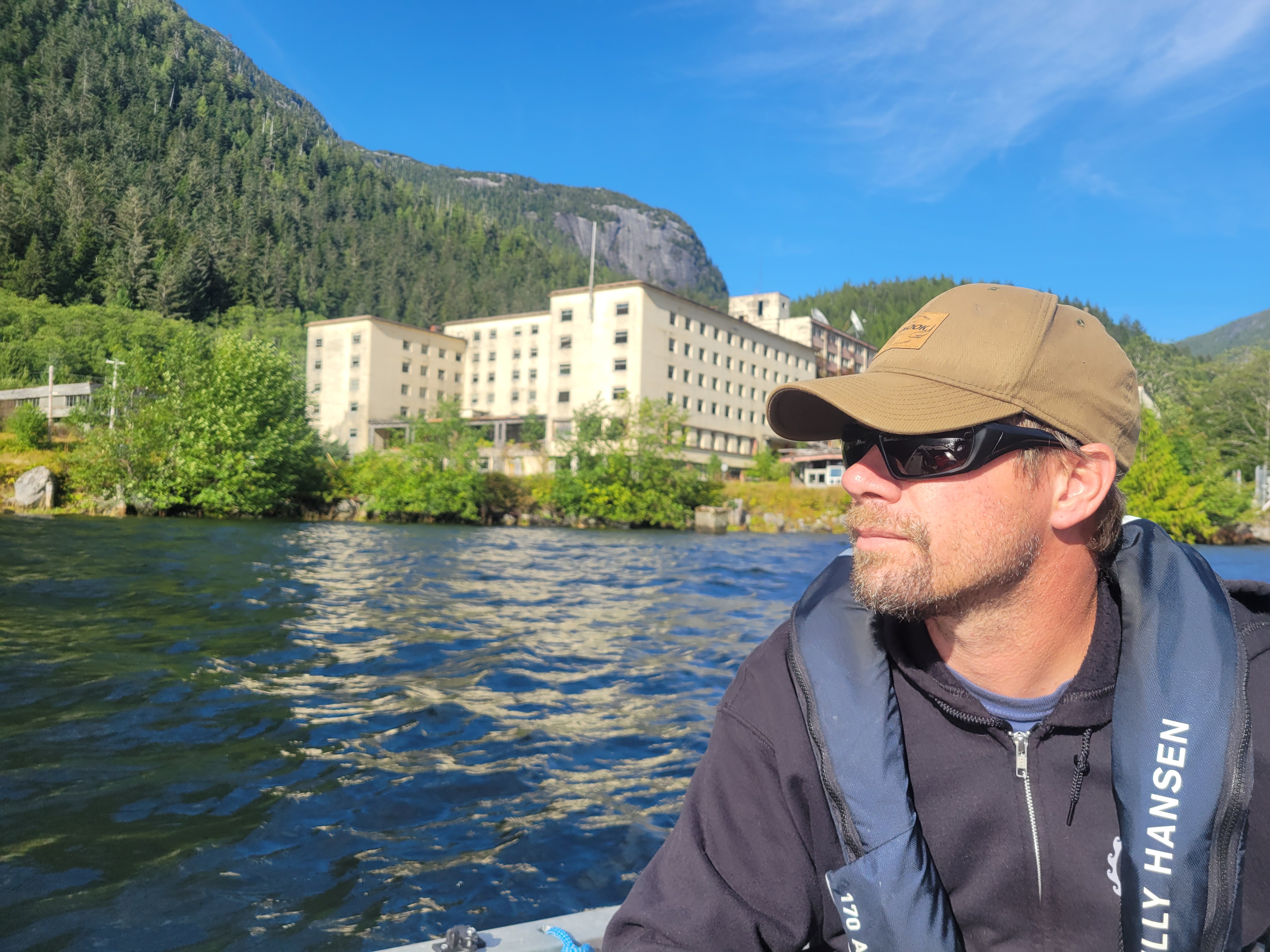
Exploring the Martin Inn
The weather was miserable when we arrived, so we stayed aboard for a bit, catching up on cleaning and small jobs. Once things cleared, we headed ashore to explore what Ocean Falls is best known for: the old Martin Inn.
Built in 1947, it was once one of the largest hotels in British Columbia, with between 370 and 400 rooms, constructed of concrete and brick right on the waterfront. When the town emptied out, the hotel was left largely intact. Over the years it’s been heavily ransacked, but it’s still possible to walk through and imagine the grandeur it once held.
Inside a Forgotten Giant
Blaine and I grabbed our headlamps and cameras and headed inside. Izzie came with us briefly, but she had Maggie, our dog, and between the broken glass and the heavy musty smell, it wasn’t a great place for either of them. She stayed outside while we went in.
Inside, the hotel felt straight out of a post-apocalyptic movie. Ceilings had collapsed, moss and vegetation were creeping in, and nature was steadily reclaiming the space. We wandered through the main lobby and kitchen, where stainless steel prep tables and old machinery still sat in place. We climbed floor by floor, walking through room after room with smashed tile crunching under our boots and missing windows opening to the rainforest outside. We explored six floors in total, which took several hours.


Ice Cream and a Living Community
Halfway through, we remembered that Izzie was still outside with Maggie, so we headed back down and met her before stopping at the Little Licker Store for ice cream. At five dollars a cone, it was an easy way to support one of the few families living downtown. The family, originally from Venezuela, runs several small businesses in Ocean Falls, including the Firehouse Bakery, where they bake and freeze goods for sale, a small meat freezer stocked from larger grocery runs, and the Ocean Falls gift shop. It’s modest, but if you want a keepsake, you’ll find one there. We picked up a small hummingbird Christmas ornament with Ocean Falls written on it for our Christmas tree.
Back Into the Hotel
Izzie and Maggie headed back to the boat, and Blaine and I returned to the hotel to finish exploring. It was eerie imagining the lives once lived in those rooms, the conversations, the laughter, and the quiet moments that all happened within those walls. Much of the copper piping has been stripped out, and it’s clear that nature will eventually reclaim the entire structure. By the time we finished, we were exhausted and decided the rest of Ocean Falls would have to wait for the next day.
Power, Water, and a Welcome Dock
One of the best things about docking in Ocean Falls is how practical it still is. Dockage was only a dollar a foot, with an additional ten dollars a day for 30-amp power. Even better, there was unlimited fresh water thanks to Link Lake and the hydro dam. Coming back to Tangaroa that evening, it was reassuring to see shore power connected and the tanks filling.

Crabbing and the Hydroelectric Dam
That afternoon, a few dock neighbours mentioned there was good crabbing near the pier. We hadn’t had much luck since River’s Inlet, so we launched Punga, our aluminum dinghy, and set a couple of traps before heading out to explore. We ran under the bridge connecting the old industrial area and the dam to the main town, then followed the river upstream to the hydroelectric dam itself. The volume of water pouring over it was impressive. The dam is now owned by a Quebec-based hydro company, and while many wonder how it turns a profit, it still supplies power to Bella Bella, Shearwater, and several nearby communities.
A Shared Meal and Plans for Tomorrow
After exploring the dam, we returned to Tangaroa and shared a relaxed dinner with some neighbours from the dock, swapping stories as the rain settled back in. Ocean Falls had already left a strong impression on us, and we knew there was much more to see. The next day, we planned to explore more of what remains of this once-bustling town and its remarkable history.

If you enjoy stories like this and exploring places most people never get to see, we share all of our travels and projects on our YouTube channels, Onboard Tangaroa – Exploring the World and The Never-Ending Sea Trial, where we document everything from remote coastal towns and forgotten history to the real-world work of living aboard our 78-foot boat. You can also find our full blog, videos, and updates on where we are now at onboardtangaroa.com, where we keep everything in one place for easy browsing. Thanks for following along — we’re glad you’re here.